The Last of Us – Episode Seven

It happened again…

I don’t know why I’m surprised every time we get a gut-wrenching episode, and I’m not referring to the baseball bat lodged in Joel’s stomach. 

Oh don’t worry he can’t die yet that wouldn’t work for the story. 

Anyways, I am really glad we finally got more on Ellies backstory. There was too much vagueness there for a bit too long I think. I mean, there are only nine episodes in this season and we get her backstory on the seventh? Seems a little late in my opinion. But as they say, better late than never I suppose. 

I really like how the entire episode built up to the point when Ellie finds out she’s immune to the fungal infection. Rather, it builds up to the event that causes her to find out she’s immune. To put it simply, she got bit. But what I also really liked is that this episode showed what she was up to before she joins the fireflies, the resistance forces. 

I liked this not so much for the character depth, which was great, but rather cause it answered a question I’ve had for awhile now. 

How is a child raised through the apocalypse?

Well, in the case of Ellie, it was military school. Makes sense. In fact, that’s probably one of the better ways to be brought up during the apocalypse, in my opinion. Also, what this episode really highlighted too is how much we take for granted in our youth. Seeing Ellie go to the abandoned mall and be absolutely mind-blown by so many simple things like a carousel sees strange. After all, such seemingly ordinary things have been staples in many of our upbringings. So, seeing it all be so foreign to Ellie really made me think about how much society would change in such situations. But more than that, it made me think back on the mundanity of my own childhood. A good one to be sure, and I’m blessed for that. Yet, it’s not something we often consider really. It’s easy to look back at the good times and reminisce, but we rarely ever think about how drastically different those times could have been. After all, we were just children and the world around us is completely out of our control. 

This episode really made me grateful for the life I’ve gotten to live. It’s been a good one.

With a bit of luck, and a bit of grit, it’ll continue to be so 🙂

Some of my favourite frames:

The post The Last of Us – Episode Seven appeared first on Watch With Zeh.

Kiss Me Lashes

I have only worn false lashes a handful of times, and when I have worn them I never applied them myself. Last week I had a function to attend, so I asked my friend who’s a makeup artist what lashes she recommends and she gave me a great list to go off of. From Walmart I picked up the Kiss Me lashes for $10. I absolutely loved how they looked. They were whimsical and made my eyes pop. I found them pretty easy to apply, and they didn’t feel heavy on the eyes or anything. I’d definitely recommend you to get these lashes if you’ve been wanting to try falsies out.

The other brands the makeup artist recommended were the Ardell ones, Quo & NYX (though she did say they can be hit or miss as sometimes they’re so fragile), and House of Lashes if you can justify dropping $20+ on a pair of lashes.

Who Is This Admin Anyways? (Process Post #12)

She’s everyone and anyone and no one! Will you ever know her truest self…?

I mean really, in a world of everyone, who is anyone?

The jellylift admin is just a fraction of my personality, and really, “jellylift admin” is a personality and character of its own. While it carries reflections of me, it is not wholly me. If I were actually this chaotic and unhinged and manic all the time I would be extremely concerned (unless I already definitely am like this, and to think that I’m not only emphasizes my delusional personality). The fact that this is just a character highlights precisely the wonders and dangers of the online world. We can be anybody we want to, which is both awesome and kind of terrifying. There is a lot of talk and discussion of being our authentic selves online, which is funny considering that at the dawn of the internet, we were all trying to hide ourselves online as much as possible. When I was a kid, I wasn’t allowed to have my name or pictures of my face anywhere online, and my parents were incredibly strict about it. In the 8th grade, when I graduated middle school, everyone was posting photos from the Grade 8 Dance, and my friends were posting stickers over my face of pictures I was in, because I simply could not have any part of me online. As the digital sphere has grown, anonymity has become harder and harder to attain, requiring individuals to go to greater lengths to smooth out their digital footprints, and clean up their breadcrumbs. 

One part of this week’s discussion on the POSIEL site is:

“what about our private, domestic, inner selves? Where do they exist in a pervasively networked world?”

I thought this was an incredibly interesting and thought-provoking question to wrap up the semester with. Is there even space for our authentic selves? First of all, so few people actually have a solid grasp on their identities and authentic selves, as people tend to craft different personas in different contexts – work, school, certain friends groups, from person to person. Second of all, I want to address a piece of the question itself. 

Our private, domestic inner selves.

I recently watched a piece called Over and Over that was created by an SFU theater student, and performed by a very talented group of first years in the theatre program. It was a sort of contemporary performance-art type of piece, addressing the ‘bedroom self’ and uncovering the different parts of who we are, alone in our bedroom. It had a drag rock-n-roll aesthetic, with my key takeaways being themes of self-love, depression and self-destruction, acceptance, and pure euphoria – among other things. Our private, domestic inner selves made me reflect on this piece, and the way this art form was used to convey that version of the self. But that’s not entirely my point of bringing it up.

The audience was very strictly directed not to take photos or videos, as it was prohibited and being professionally documented by a crew of people specifically for the SFU archives. Yet, I caught people secretly recording parts of the show, and even caught one of my friends taking some videos. Later as I was doom scrolling through Instagram, I observed how my friend had then posted that video to her story along with some pictures.

Ironic, don’t you think? A play about the private, secret, hidden inner self, posted on Instagram! 


When you think about it, our inner private selves, so long as we are connected, can’t exactly stay hidden. We repost a funny meme, and that reveals a piece of our humour. We post an opinion or a comment, and that reveals a piece of our mind. We post a photo of ourselves, and whether it is staged or not, that still reveals a piece of us.

 I guess my point is that maybe our domestic inner selves cannot exist within the “pervasively networked world,” but must remain in a separate, disconnected universe.

Like our bedroom.

Process post #10

This week I decided to take a closer look at plugins that are avalible and mitgh be usefull to impliment inmy websote, so far I decided that a plugin called One Click Accessibility would be a nice addition to my websote. This widget gives user an option to change the colors of the pages and well as font size to make it more readable. The nice touch is that it also works fine on a phone version of the website. As Sam Hollingsworth said in his article “15 reasons why your business absolutely needs seo“, “User experience has become every marketer’s number one priority.” And even though I am a bit scepticle that anybody outside of PUB101 will see my website, it is still a nice touch to make sure that user will get as pleasent expirinece as possible.

Talking about users also, this week we were introduced to Google Analytics, it is a nice website that shows all information about users that visiting my web. The strange thing is that is shows that almost a quarter of all my users are coming from France. Considering that I am trying to make my website browsing expirience a pleasant time spender, I still hope that it is not actuall international user and somebody just using VPN while browsing my website, but just incase I added a plugin that translates my website text in to French.

P.S. Profiter de regarder

References:

Hollingsworth, S. (2021, August 9). 15 reasons why your business absolutely needs seo. Search Engine Journal. Retrieved March 25, 2023, from https://www.searchenginejournal.com/why-seo-is-important-for-business/248101/#close

process posts#12

The commonplace understanding of comments sections as terrible comes from the prevalence of online abuse and harassment that can occur in these spaces. Online abuse and harassment can take many forms, including hate speech, cyberbullying, trolling, and doxxing. These behaviors can be harmful and intimidating, especially to individuals from marginalized groups who are already underrepresented in online spaces.

Despite the risks, many sites have comments sections as a way to encourage engagement and foster community. Comments sections can provide a platform for readers to share their thoughts, offer feedback, and engage in dialogue with each other and with content creators. However, sites need to take measures to ensure that their comments sections are safe and inclusive spaces that promote healthy discussion.
while comments sections have the potential to foster community and engagement, they can also be hotbeds for online abuse and harassment. Site owners can promote healthy discussion and create a safe and inclusive space by establishing clear guidelines, investing in moderation, and taking swift action against abusive behavior.

reading

Jon Ronson’s 2015 article “When Online Shaming Spirals Out of Control” explores the phenomenon of online shaming and its potential to spiral out of control. Ronson argues that the internet has created a culture of shame in which individuals can be publicly shamed and humiliated for perceived wrongdoings, often without due process or consideration for the consequences.

The article highlights several high-profile cases of online shaming, including the case of Justine Sacco, who tweeted a poorly thought-out joke about AIDS before boarding a plane, only to find that the tweet had gone viral and resulted in widespread condemnation and harassment. Ronson argues that online shaming can be a form of collective punishment that can have long-lasting and devastating effects on the individual being shamed.

Ronson also explores the psychology behind online shaming, including the role of empathy and the impact of anonymity. He argues that online shaming can be a form of moral outrage that allows individuals to signal their moral superiority and feel a sense of belonging to a larger group.

Overall, Ronson’s article raises important questions about the ethics of online shaming and the impact it can have on individuals and society as a whole. It highlights the need for greater empathy, nuance, and context in online discourse, and the importance of considering the consequences of our words and actions in a digital age.

process posts#11

When it comes to reading online, people tend to scan and skim content rather than read word for word. This is because online content is often presented in a format that makes it easy to quickly digest, such as short paragraphs, bullet points, and subheadings.

In terms of different channels reinforcing each other, it can be effective to have a presence across multiple platforms, such as your website, social media, and email marketing. This allows you to reach your audience in different ways and ensures that they are more likely to see your message. For example, you might share a new blog post on your website and then promote it on social media, which can help drive traffic back to your website.

Bryce J Renninger’s 2014 article “Where can I Be myself… where I can speak my mind: Networked counterpublics in a polymedia environment,”: Networked counterpublics in a polymedia environment” explores the concept of “counterpublics” in the context of online media. Renninger argues that networked counterpublics, which are alternative public spheres created by marginalized groups, have become increasingly important in a polymedia environment.

The article examines how networked counterpublics are created and sustained through a variety of online platforms, including social media, blogs, and forums. Renninger also explores the ways in which networked counterpublics can reinforce and amplify each other, creating a broader impact on public discourse.

Overall, Renninger’s article sheds light on the ways in which online media can be used to create alternative public spheres, and the potential impact these counterpublics can have on shaping public discourse.

Process Post Eight

Before a couple of minutes ago, I had no idea what transmedia story telling was.

According to Wikipedia, transmedia storytelling is “the technique of telling a single story or story experience across multiple platforms and formats using current digital technologies”. 

This got me thinking about how I could adopt more transmedia techniques to what I’m doing here.

So, I did some more research and found Dream Farm Studios’ “What is transmedia storytelling? Theory to practice +Examples & Case Studies“. What I discovered is that transmedia storytelling isn’t really a very new concept. That, and it isn’t really something I can adopt in its traditional sense. Take for example The Witcher series. Am I talking about the videos games? The tv series? Or the books? 

The Witcher started out as a book series, adapted into a video game, and then adapted into a television series. This is a perfect case study of transmedia storytelling. What we see is the same story being told and adapted into different formats. In the case of The Witcher, it went from book, to video game, to tv series. 

So how would this idea work for me?

First, this blog is definitely not going to see video game, nor television adaptation. I fear even I would not want to consume that media. Although it could be something like “blog writing simulator”. It could compete with lawn mowing simulator for sure. 

Anyways, jokes aside I think transmedia storytelling would work pretty well for me. Where it differs from its traditional techniques is in how and what it is adapted to. So, instead of being turned into tv, or video game, my blog could see different versions of its content. The idea at play here is very similar to just repurposing content, though it has potential to go beyond repurpose. 

Some ways in which I can apply transmedia techniques to my blog would be taking my content and putting it in different formats. What this looks like can be the start of a YouTube channel. The reason Youtube would be a really good launching point is because I can take my written content and make full length video content based off of it. From those YouTube videos, I can use a clever bit of editing and turn it into a YouTube short, Instagram Reel, and a TikTok video. Now, if I were even cleverer I could even have my YouTube videos script written such that an audio only version of it could serve as a podcast available on Spotify or wherever else podcasts are found (can you tell I never hopped on that trend). 

So, if I were going to adopt transmedia techniques, that’s how I’d do it. 

The post Process Post Eight appeared first on Watch With Zeh.

Scrolling Through The Shadows

Process Post #12

3 text bubbles that contain angry and sad emojis.
Swim Creative

As an 18-year-old female who has been active on several different social media platforms, I’ve seen my fair share of negative comments. While I always knew they were unpleasant, I never realized just how much of an impact they could have on my mental and physical health.

In the readings this week, Maria Konnikova’s “The Psychology of Online Comments” explains that “negative comments can trigger our brain’s stress response, leading to feelings of anxiety and even physical symptoms like increased heart rate and blood pressure.” (Konnikova, 2013). Yes, you read that right, physical symptoms from online comments! That is serious stuff.

Comments can also affect our self-esteem, making us doubt ourselves and our abilities. I’ve definitely experienced these effects firsthand. When someone leaves a comment saying I “don’t know what I’m talking about”, or if I don’t get a “like” from a friend, it’s hard not to take it personally. It also makes me question everything I post. Even if I know that I’m doing my best and that I’ve put a lot of time and effort into my content, negative comments can still bring me down.

Joel Stein’s “How Trolls are Ruining the Internet” takes a broader look at the culture of hate on the internet and the ways in which it’s shaping our online interactions. He argues that social media platforms like Twitter and Facebook have “made it easier than ever to attack and harass others, and that this has contributed to a larger culture of negativity and hostility online.” (Stein, 2016).  I’ve seen this firsthand this week at SFU, where hateful comments have exploded on the SFU Athletics social channels in response to cancelling the football team. It makes me worry about the kind of world we’re creating online.

While it’s impossible to completely eliminate these kinds of hurtful comments, I think it’s important for all of us to work together to create a more positive and supportive online environment. This means standing up against hate speech and harassment, but also actively promoting kindness and empathy in our own interactions with others.

I make an effort to respond to comments in a positive and respectful way, even if I don’t necessarily agree with what someone is saying. I ensure my comments are constructive, not critical. I think it’s important to remember that behind every comment is a real person with real feelings, and that we have the power to either uplift or tear down those around us.

As a blogger, I try to do my part by moderating comments and deleting those that are particularly hateful or hurtful. I decided that ensuring my blog is a safe and positive environment for everybody is more important than my SEO and potential site traffic. So, I am keeping my restriction on anonymous comments. While this reduces the number of comments I receive on my site overall, it limits the amount of hate comments, as people are less likely to spread hate when their name and email are attached. Additionally, comments must still be approved by me, so I can delete anything negative. I also went into my comment settings and blocked certain words. Comments that contain words such as ugly, stupid, or die, along with slurs, will automatically be put in the trash. Hate has no place on my website. As I was reflecting, I decided that I have no problem with some swear words in my comments, as my site isn’t exactly geared towards kids. However, I did block a few of the more graphic swears. I just don’t want to read comments containing those words, whether they are hateful or not. I am hoping these adjustments limit the potential hate I receive, as well as hate towards other commenters and the people I write about.

By working together to promote kindness and empathy, I think we can create a better online world—one that’s more supportive, more inclusive, and more respectful of everyone’s right to express themselves freely and without fear of harassment or ridicule.  If that doesn’t work I am all for a good old fashioned social media cleanse.

Check out benefits and ways to detox from social media here!

Works Cited

Konnikova, M. (2013, October 23). The psychology of online comments. The New Yorker. Retrieved April 8, 2023, from https://www.newyorker.com/tech/annals-of-technology/the-psychology-of-online-comments

Stein, J. (2016, August 18). How trolls are ruining the internet. Time. Retrieved April 8, 2023, from https://time.com/4457110/internet-trolls/

Social Media Overload

Process Post #11

Cartoon women holding a laptop. She's surrounded by a ring of different social media icons.
Express Analytics

We are constantly inundated with messages about the importance of having a strong social media presence. From Instagram to TikTok to Twitter, there seems to be an endless number of platforms to choose from. While I understand the benefits of connecting with others and sharing my experiences online, I find myself feeling hesitant and even fearful about creating multiple social media channels.

One reason for my reluctance is the pressure to present a certain image of myself online. As one of our readings, by Bryce Renninger discusses in “Where I can be myself … where I can speak my mind” (Read that article here!), social media has become a space where individuals can curate their identities and project a certain image to the world. While this can be empowering, it can also be exhausting. I worry that by creating multiple social media channels, I will have to constantly monitor and update each one to ensure that I am presenting the “right” image of myself. I also have to create unique, curated content for each social channel, and I worry that all that extra work will suck the fun out of my blog.

This pressure to conform to societal expectations can be overwhelming, and it is one of the main reasons why I hesitate to create multiple social media accounts. Personally, I only use Instagram because I found that other socials were harming my mental health. Constantly keeping up with them was to much for me, and I felt I was missing out on my own life. Although, I did create a TikTok for “Friday’s with Frosty” to expand my content (Check it out by clicking here!), each time I posted, I deleted the app. I felt this kept me from getting hooked and falling into a negative spiral. Every time I wanted to create a new video, I had to re-install TikTok. In fact, as soon as this class is over I will be deleting my TikTok account for good.

Another reason for my reluctance is the fear of being judged or criticized. In today’s society, it seems like everyone has an opinion about everything, and social media has only amplified this phenomenon. While I understand that not everyone will agree with everything I post online, the thought of receiving negative comments or criticism is daunting. Renninger’s discussion of networked counterpublics in a polymedia environment resonates with me here. Social media has created a space where individuals can connect with like-minded people and form their own communities. While this can be a positive thing, it can also create an echo chamber where opposing views are not heard or acknowledged.

Despite my fear and reluctance, I do see the value in social media as a tool for storytelling and self-expression. My blogging experience has empowered me.  I like the pace—no pressure to post everything all the time. I like the space—I can fully develop my thoughts and ideas without character limits. I really like that I don’t feel that pressure to constantly check my posts—I am not tied to likes. The fact that I don’t have followers also takes some of the pressure off. When I am writing I don’t think about all the people who will see my content. I am just able to write what I think. It is freeing.

Although I have my issues with social media, I came up with ideas for a potential “Fridays with Frosty” expansion. All this content would create traffic back to my blog.

An infographic titled "Friday's with Frosty Multiple Channel Expansion Plan" beside cartoon social media notifications. 

Section 1 - TikTok
Continue making trend videos, "my ratings", and  "this or that" content. Include celeb drama breakdowns or "beef backstories". TikTok logo accompanies text. 

Section 2 - Instagram 
Create pop culture memes and "clickbait" posts that connect to my other content. No reels. Instagram logo accompanies text. 

Section 3 - Youtube 
Podcast-style videos with special guest appearances. Different opinions. YouTube logo Accompanies text. 

Section 4 - Twitter
Sarcastic one liners. No threads. My first thoughts/  floating out content ideas. Twitter logo accompanies text. 

Section 5 - My Blog 
Continue writing article-style commentary on pop culture. Cartoon webpage accompanies text.

Works Cited

Renninger , B. (2014). “Where I can be myself … where I can speak my mind … – sage journals. “Where I can be myself … where I can speak my mind” : Networked counterpublics in a polymedia environment. Retrieved April 8, 2023, from https://journals.sagepub.com/doi/10.1177/1461444814530095

WEEK 12

It is now the final week of this class and I’m completely done writing everything except this last process post. I thought I could summarize my entire process of creating my blog as this is the last post. In the beginning my site was a very simple one page with all my content coming one after another. The background was white and the text was black, everything was really simple and lacked any personality besides the few pictures I had at the time. After a while It was getting really cluttered and confusing to distinguish what type of post you were reading so I decided to try something new with having the homepage be just a page with 4 buttons, one for content posts, one for process posts, one for mini assignments, and one for peer reviews. I liked the style of this because it was really simple but at the same time it made the homepage an extra step to get anywhere on my site and I knew eventually it wouldn’t work because I had to add more sections for the essay and about me. This made me once again change the style up completely to what I have now. Now the homepage acts as the content posts page and has a navigation bar at the top to get to every other part. The sections I have are for home (content posts), process posts, mini assignments, peer reviews, my essay, and about. I changed the background colour to an off white as it’s a little easier on the eyes and I also added a dark mode for if you’re using my site late at night. I think it’s been a very tough process to get to where I’m at now, especially with all the trouble I had at the start to even get my site to work in the first place, but I’m happy with where it’s at for now. The readings this week are mostly about community guidelines and comments. The readings; The Psychology of Online Comments and The dark side of Guardian comments, talk about how interactions on the internet are oftentimes more aggressive and negative compared to real life. They mention the online disinhibition effect which explains why people say things they wouldn’t say in person because of the sense of detachment and anonymity they get from being behind a screen. It also talks about trolling which is when people post comments they know will make you have a reaction and they get joy from the attention they receive when you respond to them. I don’t think this necessarily affects my website as I have yet to receive any comments on my posts and don’t think anyone actually reads the content I’m posting but I will definitely take this into account when using the internet elsewhere for example on social media. I don’t think the best way to combat this is by removing comments and banning users as it doesn’t really affect them as they can always just make new accounts, but rather I think the best way to combat this is to just simply ignore it as if they don’t receive a reaction they’ll eventually stop

References

Gardiner, B., Mansfield, M., Anderson, I., Holder, J., Louter, D., & Ulmanu, M. (2016, April 12). The Dark Side of Guardian comments. The Guardian. Retrieved April 8, 2023, from https://www.theguardian.com/technology/2016/apr/12/the-dark-side-of-guardian-comments

Konnikova, M. (2013, October 23). The psychology of online comments. The New Yorker. Retrieved April 8, 2023, from https://www.newyorker.com/tech/annals-of-technology/the-psychology-of-online-comments 

New Directions: How the Gleeful Rise and Fall of the TV Musical Gave Way to High School Show Choir

(s1, e22)

The massive cultural phenomenon that is Glee took the world by storm when its first season aired in 2009. However, this show – which brought the idea of the TV musical to the general public – also ended the cultural phenomenon that it started. Questions of why Glee stands alone as the only TV musical to enter and exit the zeitgeist abound. Did the writing deteriorate too much? Did casting choices affect the show? Did the audience simply get bored? Is it a combination of the three? And, perhaps most importantly, what effect did this show have on the youth at the time? My personal experience with this show and the cultural shockwaves it created will hopefully shed some light on this. 

A popular opinion towards the show (that I also hold) is that Glee massively overstayed its welcome, and I believe that its bloated run tired the general audience out from any concepts that revolved around a TV musical.  After the conclusion of Season 3, the narrative was essentially over. Many of the main cast were graduating high school, and so it seemed that there was simply no more story left for Ryan Murphy, the creator of the show, to write. Therefore, when the show came back for a 4th season, some previously main characters were now relegated to a supporting role, a choice that angered many of the audience, myself included. There was no narrative need to continue, and definitely no need to continue without the cast that audiences had attached themselves to over the first 3 seasons. Additionally, the writing of the show became noticeably worse in Season 4. Perhaps the exclusion of the actors who were able to mask the poor quality of the script brought its lack of quality to light. Either way, this cast and its poor writing was endured by the audience of the show for three more seasons, losing many fans along the way. These three factors proved to be a main reason in Glee’s downfall, and indeed the downfall of TV musicals as a whole. 

However, it is important to remember that while Glee was part of the zeitgeist, it inspired many of its younger audience to start theatre and start performing in general. American high schools experienced a surge in show choirs, and the many fantastic vocal performances in the show set a bar that many younger viewers wished to recreate. The resurgence of interest in theatre in the early 2010’s due to Glee is without a doubt one of the best outcomes from this show, and the fact that its overstaying of its popularity ruined any chance of new TV musicals gaining popularity for the near future is legitimately heartbreaking for the current generation of young potential actors. Despite this, what Glee was able to accomplish as an innovator and most popular example of a TV musical is no mean feat. It is just a shame that it had to ruin the solid foundation it had built for itself and others.

Process Post #12

This is my final post on the course, and I’m sad it’s ending. That’s why it’s lengthy, as I don’t want to finish it unconsciously. The course has been a great source of enlightenment for me, both in real-life situations and online. I’ve learned many new and practical skills, which has made me enthusiastic about pursuing my minor in publishing. I’ve found something that I’m passionate about, and I want to continue with it. 


The most valuable thing I’m taking away from this course is the motivation to start my small business, which I plan to launch in the summer. My buisiness will specialize in creating texture canvas art. And I’m so excited to apply all I’ve learned  from this course to this and my future UX/UI designer career. I want to thank you Suzanne, Mickey, and my amazing classmates, for making this experience so impressive and memorable!!


 So, let’s dive into online hate topic as my very last process post topic, using a recent case study to illustrate its prevalence!

PI 21.04.28 CanceCulture featured.png
Photo credit: unsplash

The prevalence of online hate has become an infamous problem, but why has it become so normal? The power of social media can make or break a person’s life in a matter of hours. The Justine Sacco case is one such example where a tweet intended to be a joke caused an uproar on social media, and she became the target of intense online shaming.


Likewise, Iraj Tahmasb, a well-known TV presenter in Iran, faced backlash on social media after cracking a joke about the detention of girls protesting during the 2022 Woman Life Freedom protests in Iran. The joke was seen as insensitive and offensive, causing a lot of outrage among people who demanded that he be held accountable for his words.

mov 132805 55510 m
Tahmasb and his puppets-Mehmoon Series

The episode of the Mehmooni series- which takes place in a fictional wedding hall located next to Tahmasb’s newly acquired home, introduces a variety of new puppet characters who are primarily workers at the wedding hall-features a conversation between Sirus, played by Sohail Rahbar Zare, and Tahmasab. 

When Tahmasab inquired if the upcoming year would be better than the previous one, Sirus replied that the last year was much better since they took his sister. Tahmasab was taken aback and asked if his sister had been caught or had gone missing. Sirus revealed that she had gone to work on the streets and that a boy had seen her, meaning she had married. Sirus then asked Tahmasab if he was happy, to which he replied. Finally, Sirus urged Tahmasab to wish his sister happiness. The word “caught” resonated with many people as a reference to the government’s arrest of young girls during the 2022 protests in Iran.

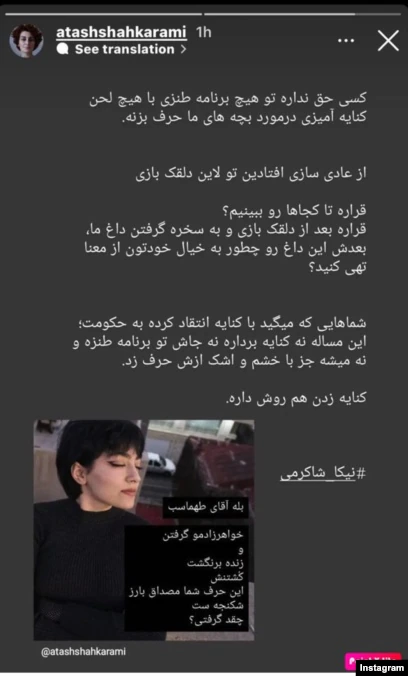
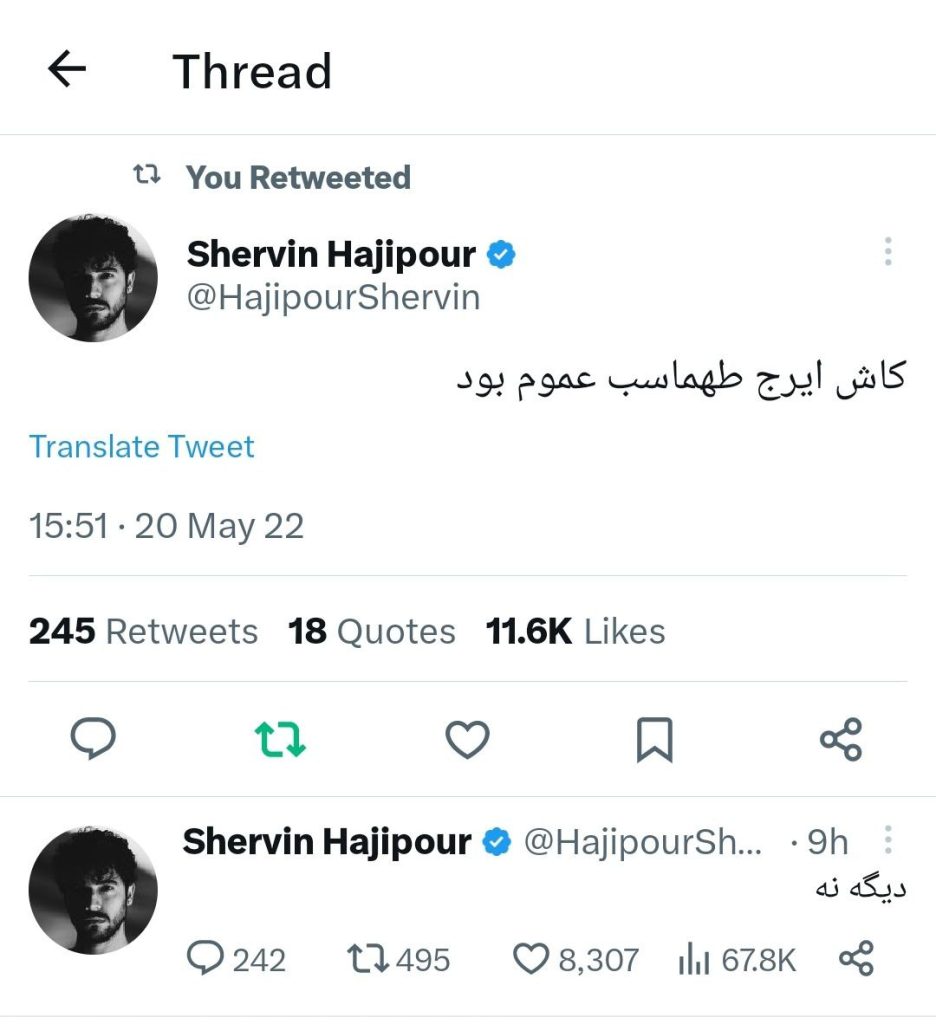
 In response to what happened on his TV show, Shervin Hajipour, the popular grammy-winner singer which I previously mentioned him in my third content post, , expressed his thoughts on Twitter as well. In 20 May 2022, he tweeted, “I wish Iraj Tahmasab was my uncle,” but in a recent response to the same tweet, he said, “Not anymore.”. Atash Shakarami, Nika Shakarami’s aunt- a victim of the uprising-noted that the joke was akin to torture. Azadeh Samadi, an Iranian actress, critiqued Tahmasb’s anti-woman speeches and views, urging him to reconsider and not ruin her childhood memories. Samadi also questioned Tahmasab about his limited use of women, to which he replied that women aren’t funny. According to Stein J. in the secrect life of internet trolls, this statement represents a clear example of misogyny towards women.

01000000 0a00 0242 9510 08db2c327c23 w408 r0 s.jpeg
Shakarami's instagram story
photo 2023 03 25 15 30 22
Shervin's Tweets
آزادهصمدی ایرجطهماسب
Samadi's Instagram post


The situation that followed could be described as an example of cancel culture. Tahmasb faced much criticism and backlash on social media, with many demanding his dismissal and boycotting him. This incident caused a ripple effect, with many social media users expressing disappointment and anger towards Tahmasb’s actions. Some individuals even went as far as to label his comments as misogynistic and disrespectful towards women. However, many others believed the situation was a misunderstanding and was blown out of proportion. This occurrence sparked a lively debate about the responsibility of comedians to be sensitive to social issues and the role of humour in society.


The problem with cancel culture is that it often leads to a rush to judgment, with little regard for due process or the facts of the case. In the case of Tahmasb, I believe many people jumped to conclusions without actually watching the segment in question. Instead, they reacted to the outrage on different websites and platforms comment sections with a biased mind-set and joined the condemnation bandwagon.


This is not to say that Tahmasb’s allusion was in good taste. It clearly was not. But the rush to judgment and the intensity of online shaming is a worrying trend that is becoming all too common in our digital age. We have to be careful to keep the power of social media from leading us to a place where we lose sight of the value of free speech and the need for open dialogue.


Another frequent critique of online commentary is the potential mismatch between a commenter’s stated views and their actual identity. This reminds me of the “online disinhibition effect,” a phrase coined by John Suler, which I find particularly relatable.


I believe when people are online, they may act differently than they would in person because they can remain anonymous and have no real consequences for their actions. This can sometimes result in them expressing themselves hostilely or disrespectfully. Additionally, factors like group dynamics, their emotional state, and their desire to fit in with others may influence how they behave. 


Konnikova, in the Psychology of Online Comments, suggests that negative behaviour in comment sections is complex and influenced by psychological and social factors while also pointing out that the way comments are displayed or moderated can impact behaviour. To promote respectful interactions, online platforms and individuals have a role.


No matter where you stand on the issue, I think it’s pretty evident that online bullying and harassment are happening more often than ever. Guidelines are set up for commenting to ensure everyone is having kind and respectful discussions online. But let’s face it, and not only some people follow these rules. So it’s up to us to be careful with what we say and do online.


I’m not trying to defend Tahmasb, but it bothers me how trolls and cancel culture have taken over in this digital age. Even if someone has an excellent track record and is highly respected, one mistake can lead to them being cancelled without considering everything they’ve accomplished. It’s essential to address online abuse and harassment; treating others with respect and kindness online is just as crucial as in person. The case study I mentioned highlights that we all have a part to play in creating a positive online community.


Based on the discussion of the dangers of cancel culture and the power of social media in the case of Iraj Tahmasb, online communities need guidelines to ensure that they are safe and inclusive spaces for all. To achieve this, it is essential to develop community guidelines that balance free speech and social justice while promoting open dialogue and constructive criticism.


We Need to Talk About Cancel Culture 1024x423 1
photo credit: unsplash

The proper guidelines will vary depending on the specific site and its goals. Still, some key considerations might include rules against hate speech, harassment, and bullying, as well as guidelines for respectful disagreement and constructive criticism. Additionally, it may be essential to have clear policies around anonymity and pseudonyms and procedures for reporting and responding to guidelines violations.

As mentioned by Ball in the Dark Sides of Guardian Comments, implementing these guidelines will require combining technology, moderation, and community engagement. This might involve using automated filters to detect and remove abusive content and human moderators who can review and address reported violations. It will also be essential to involve the community in the moderation process through mechanisms such as user reporting and feedback and community-led initiatives to promote positive and inclusive discourse.


Developing and implementing community guidelines is crucial to creating safe, inclusive, and constructive online communities. By balancing the need for free speech with the importance of social justice and open dialogue, we can create spaces where everyone feels welcome and valued and work towards building a better and more tolerant society.


 In onclusion, the case of Iraj Tahmasb is a cautionary tale about the dangers of cancel culture and the power of social media to influence public opinion. We must learn to balance the need for social justice with the value of free speech and the importance of open dialogue. We need to create a culture where people feel safe to make mistakes without fear of being cancelled or ostracized. Only then can we hope to build a truly inclusive and tolerant society?

Bibliography: 


Ball, J. (2016, April 12). The dark side of Guardian comments. The Guardian. https://www.theguardian.com/technology/2016/apr/12/the-dark-side-of-guardian-comments


Konnikova, M. (2013, October 28). The psychology of online comments. The New Yorker. https://www.newyorker.com/tech/annals-of-technology/the-psychology-of-online-comments


Ronson, J. (2015, March). When online shaming goes too far [Video]. TED Conferences. https://www.ted.com/talks/jon_ronson_when_online_shaming_goes_too_far?language=en


Suler, J. (2004). The online disinhibition effect. CyberPsychology & Behavior, 7(3), 321-326. https://doi.org/10.1089/1094931041291295


Stein, J. (2016, August 18). The secret life of internet trolls. TIME. https://time.com/4457110/internet-trolls/

Process post #9

This week reading “Digital breadcrumbs: the data trail we leave behind us” brings concerns of our private life and what in the era on cellphone is shared with public. Most of the activity we do with our phone requires a location in one way or another, there is a constant trackong of where we are and what we are doind to a certain extend. For instance most sites right now ask permition to use “coockies”, sounds delicious let’s hope it has a chocolate chip in it, but in reality it saves information about what you were looking for and later this information could be used to target user and shpw them similar iteams they might be interested in. Have you notice a new phrasing on iphone when you download a new app, it does not ask you if you give permission for collectiing info, now it say “ask app not to track you”, it is put in such nice wor but in the end you can not be sure if app will follow your wish, since you did not explicitly say DO NOT track me. Social media comapanies are implementing options that give you a chance to sign in in app using your Facebook account, which only makes ther data server save more info about you.

Of course it may sound intimidating, there is always a doubt that big firms will be honest and will not use your private information to harm it user. And I do not mind most of the time for my data to be collected about me, I would rather see something in my firld of interest than a completly random stuff. (As long as it is not Meta, all the scandals around it makes me weirdly worried, and that’s why I barely use it )

References

Philip, G., Lazo, J., Jamali, R., & Jaroodi, R. (n.d.). Digital Breadcrumbs: The data trail we leave behind us. Pod Academy. Retrieved March 21, 2023, from http://podacademy.org/podcasts/digital-breadcrumbs-our-data-trail/

The feminist message of The Yellow Wallpaper

As someone who enjoys reading feminist literature, I found “The Yellow Wallpaper” by Charlotte Perkins Gilman to be a fascinating and thought-provoking read. The story provides a powerful commentary on the patriarchal society of the time and the ways in which women were oppressed and denied agency in their own lives.

“The Yellow Wallpaper” is a classic short story by Charlotte Perkins Gilman, published in 1892, that explores the issue of female oppression and the limitations imposed on women in Victorian society. The story is often regarded as a seminal work in feminist literature and is renowned for its powerful commentary on gender roles and the patriarchy.

The protagonist of the story is a woman who is suffering from what is presumed to be postpartum depression and is confined to a room in her husband’s mansion. As she spends more time in the room, she becomes increasingly obsessed with the yellow wallpaper that covers the walls, and begins to see disturbing patterns and figures within the wallpaper. The story is a powerful exploration of the protagonist’s descent into madness and the ways in which she is oppressed and controlled by the patriarchal society in which she lives.

it exposes the ways in which women are oppressed by a society that denies them autonomy and agency. the main character is prevented from leaving her room, engaging in any kind of productive work, or expressing herself creatively, all of which contribute to her sense of isolation and despair. Her husband, who is a doctor, dismisses her concerns and insists that she simply needs rest, effectively silencing her and rendering her voiceless.

The story is also a commentary on the issue of mental health and the ways in which women’s experiences are often ignored or dismissed by male doctors. The protagonist’s husband, who is a doctor, insists that she simply needs rest and denies her access to other forms of treatment, contributing to her worsening condition. The story highlights the importance of recognizing women’s experiences of mental illness and the need for more compassionate and holistic approaches to treatment.

Latte Art Attempt #8

a latte with a stacked leaf design on it.
I haven’t tried anything new or exciting recently, but I did unintentionally create this cool leaf shape that I thought I would share!