Tag Archives: Posiel

Play when…it’s too early

Go to bed late, wake up early. Repeat. 

I don’t know about you, but that’s what my disintegrating sleep schedule has been like during this final stretch of the semester. I mean, I haven’t travelled anywhere out of the 10km radius of my house for the past couple of days but I’m walking around like I’m jet-lagged. 

Thank you, term papers.

And hear me out, waking up is hard. Getting up while it’s still dark outside seems counterintuitive, my body clock believes otherwise, and it doesn’t seem fair to trade your warm bed for the cold touch of the bathroom floor. I did not sign up for this. 

But alas, another day, another morning. 

So here’s a playlist to ease your delicate self out of bed and into the world that seems to be throwing everything at you as of late. 

Sound on & wake up slow. 

Peer Review #2

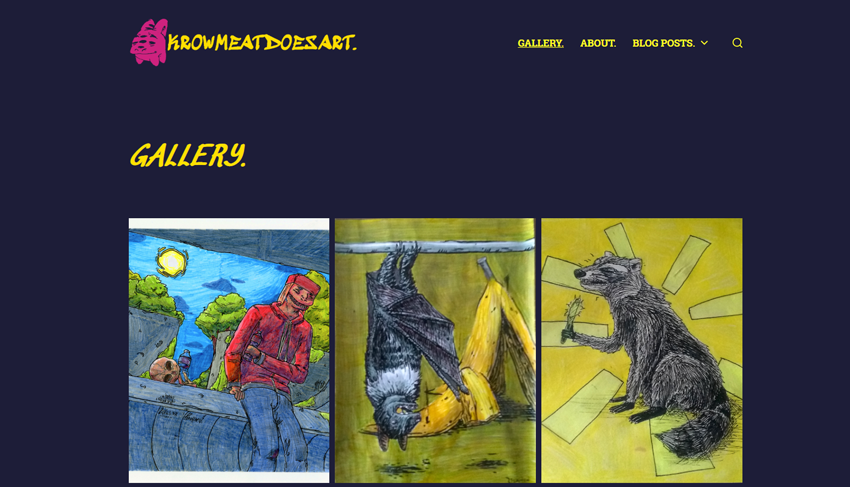
Today I am reviewing Lucas’s art blog Krowmeat Does Art. I have previously been to his site before and find his aesthetic somewhat amusing. It is a mixture of creepy meets purposely gaudy. The colour story of his blog consists of a saturated dark blue and a very bright yellow. This coincides with his general art style which is also primarily made with glowing primary colours, heavy line art, and graphic novel inspired as illustrated below:

Along with the artwork he has currently posted in his blog, he also has linked an instagram which showcases other artwork as well as a twitter account. He has an “About” page which gives further insight about who he is as a creator and what his online persona is like. In some of his posts, Lucas muses about his art process and other artists he gains inspiration from.

Lucas’s blog is fairly easy to navigate. It has different categories that separate class posts from general posts and art posts, and also includes a nice menu tab on the upper left corner. There are some grammatical errors present in posts, however, said posts are exceedingly casual in tone. Thus, I find no issue with that. Again addressing the blog’s aesthetic, but it is possible he may alienate potential viewers. It is definitely an aesthetic chosen for the author rather than his audience, however, I understand it and I do not feel he needs to change it considering his blog is aimed at a more casual rather than professional crowd. Content wise there is not much to add. Lucas is clearly updating regularly, and has a decent amount of artwork and posts on his blog in addition to his social media pages.

As a former art student myself, it is nice to take a slightly deeper dive into another’s process and aesthetic. If I was to add a bit of wisdom I received from my own art professors, I would recommend also having a more business professional website or social media contact if Lucas wishes to monetize or sell his skills in the future. It is a very difficult thing as an artist to accept that sometimes you have to sacrifice your own tastes a bit and make a compromise in order to get your foot in the door so to speak. That said, I am certainly not saying he should or has to follow this advice. I am merely pointing out that the art world is a fickle mistress. Overall, it is a good blog and I look forward to more posts from him.

Peer Review #1

For this Peer Review assignment, I will be reviewing Mehtab’s blog, Vancity Exotics. It aims to “create a clean, minimalist, and futuristic website” about cars and car culture. As of right now, there appears to be little implementation regarding this specific topic. In “Process Post #2”, Mehtab expresses that this is, in part, due to his busy schedule. He also feels frustrated regarding the aesthetics of his website. Personally, I feel he has accomplished a fairly nice and clean looking website. Granted, I completely understand his frustration. The only aesthetic issues I see involve the inconsistency with the banner text-type as illustrated below:

I do not feel this is more than a nit-pick, however, I felt it should be noted. The simpler text type on the bottom image I feel is a better fit in comparison to the fancier one above. Particularly due to Mehtab’s statement that he wants something that feels “minimalist” and “futuristic” is accomplished on a rudimentary level. The black, white, and grey colour story is nice and easy to read. As for user interface improvements, either having a tab bar or set categories would be useful. Currently, most posts appears to be listed under the sole category “uncategorized”. This makes it a bit difficult to navigate between posts related to the website’s topic versus process posts or assignments from class. Not all of his posts are under this category as well, which makes navigation a tad more cumbersome. Content wise, as stated before, is somewhat bare and I would suggest adding an introduction page to really emphasize what he enjoys and knows about cars and car culture. As of right now, the only thing that shows his audience what his website is about are the header and “Process Post #5”. In terms of an “online self” being created on this blog, there is not much. I believe Mehtab wants to keep his identity somewhat anonymous for the time being. Overall, taking a look at a peer’s blog was a great way to see how students express themselves in different ways with the same tool set. I think it is an inspiring thing to see, even with personal struggles.

Process Post #9: Crunching the Numbers

This past week, we focused on global internet trends and activities with the help of Mary Meeker’s, “2019 Internet Trends Report”. We pinpointed where the greatest hubs of web users are around the world, which sites see the most traffic, and what details we can infer from all of this user activity—all of that fun stuff. So of course, you know the drill, it got me thinking. 

I know, whatta surprise. 

LUCKY NUMBERS

All this talk about numbers and data suddenly had me questioning my own. I won’t lie, I’ve neglected considering my analytics for the past couple of weeks (because, life) but this gave me the motivation to get back into it. 

It’s always fun to see behind the scenes of user activity. I’d even say that Travis Gertz hits it right on the head in his article, “Design Machines: How to Survive the Digital Apocalypse” when he describes analytics as “hav[ing] seem­ing­ly god-like access to the ways peo­ple use our prod­ucts”. 

With analytics, we’re given information like where our users are located, what content they like to interact with, and what devices they use to get to our sites. It’s like using a highly-developed, electronic, statistically justified Magic 8 ball. (Okay, so it’s nothing like using a Magic 8 ball.)

In saying so, now that I’ve seen last week’s stats regarding which devices are being used to visit the blog, I know that I should give more thought into what it’s like to visit Moods & Mixtapes via a mobile device. 

YOU’RE JUST TOO GOOD TO BE TRUE

Although, as life-changing and beneficial as it all sounds, I need to remember to not get too ahead of myself. As Gertz bluntly puts it, “met­rics are the internet’s hero­in”. And despite how absolute we may think the numbers are, they cannot always be trusted. We can’t just be making all of these changes just because the data led us to think they were necessary. 

Take it all with a grain of salt, I suppose.

process post #10

I still remember reading about this guy who claimed he came back from the 3700 future and warned everyone that humans will be controlled by robots. Back in 2005, this sounded like some sci-fi non sense to me. Now that is 2019, I’m totally convinced that guy did came back from 2046. Although for now humans aren’t slaves of gigantic robots that look like the transformers, we have already become slaves to technology. It’d be a really technological determinist thing for me to blame technology for changing how we live, but I can’t help but ponder about the increasing technological influence in our daily lives. I remember Suzanne brought up the example of how a girl suddenly got a bunch of baby and pregnancy products recommended to her when her menstruation tracking app realized she missed her period that month. I think it’s really ironic how we invented all these app and technology to make our lives better yet they seem to shape the way we live now. Knowing how powerful and profitable technology can be, it’s hard for Google to not consider about building a search engine that comply with China’s censorship on sensitive content since China has a big market. Facebook also realizes its power owing to infrastructural imperialism that it can launch Free Basics to third worlds and offer them Facebook as a substitution of an actual internet, branching out their power across the globe regardless of how useful their technology actually is. Reading about these news just reinforces how technology has a dominating power in the world we’re living in right now, it might not even take 2000 more years to get to the point where we are completely controlled by robots.

References:
Brian Fung. October 16, 2018. Google really is trying to build a censored Chinese search engine, its CEO confirms
Mike Elgan. 2016. “The surprising truth about Facebook’s Internet.org.” http://www.computerworld.com/article/3032646/internet/the-surprising-truth-about-facebooks-internetorg.html#tk.rss_all

Process Post #10

What is fashion, and what is style? That’s a question that I’ve more or less asked myself ever since starting this post. Often times, people like to associate “style” with how prestige an item is, or how esthetic it appears. But really, value, as well as beauty, are in the eye of the beholder. One shirt may look stunning to me and worth $100, but to someone else, it may look plain enough to only spend $20. Personally, I grew up accustomed to shopping in large department stores such as Forever 21. For my entire High School life, I’ve tried to find my own style and clothing that fits me. The majority of my purchases never survived the stand of time, and either deteriorated or got tossed to the back of my closet, never to be worn again. It wasn’t until last year, that I really changed my mindset regarding purchases: there is no point in buying a $20 shirt that I will wear once. Instead, I would rather spend $100 on a shirt that I will feel confident in and wear multiple times. Those $20’s add up, and in the end, I am not receiving nearly as much utility as I would if I had just bought what I actually wanted.

Of course, this is all a privilege. Many people don’t have the luxury to buy what they want, nor have the means to purchase enough items to find their style. In the end, I think that your own style is whatever makes you feel confident. There is no better or worse, and more expensive does not always equal better quality or more utility.

Process Post #8 | Analytics


NIX NAVIGATES ANALYTICS

Based on the data of my website on Google Analytics, I can see a breakdown of information for the visitors of my website which helps me identify an audience that I can target my content to. Looking at the information, it gathers that 96% of the users on my website are from Canada, with the other small percentage consisting of users in the United States, and one user from United Arab Emirates. This is expected since I write content revolved around Vancouver businesses. Knowing this, I can continue my local approach without having to provide additional context than non-Canadians might not understand.

 I can also see which day of the week, and what time of days my site gets the most visit. This can help me better schedule my posts to when my audience is active and online. Rather than uploading posts on my schedule, I can set specific times for my posts to go live for engagement to be most effective. Analytics for user demographics and their interests are provided which can help guide my blog posts. I can identify which type of recommendations my readers will be most interested in and target my posts to retain their interest and keep readers from coming back to my website.

YOUR INFORMATION

MY INFORMATION

At first glance, I was actually shocked to see how many categories Google has listed under my interests and preferences. I personally don’t mind if Google has access to my information for marketing purposes because in my mind, if I’m going to get ads anyways, I would prefer if they related to my interests. I find ads to be bothersome if they spam a website and are completely irrelevant. But if ads actually promoted something I am interested in, for example, a sale at stores I usually shopped at, or products I am actively searching for, I find the ads to be informative and actually useful. I guess that’s how Google has been able to achieve the success it has, by delivering relevant ads. Although my online privacy is a trade-off for personalized ads, I don’t think anything I do online is very information-sensitive. 

That being said, let’s look at what googles to be my interests. Google has my gender and age correct, however, the first couple of categories listed as my top interests are actually not my interests at all. Royal Bank of Canada, Wayfair, Best Buy, and Sunwing Vacations are listed as some of my top interests, yet I’ve visited or discussed these websites/brands less than a handful of times in my life. Glancing at the comprehensive list Googled has complied for me, I do see that it encompasses majority of my interests, but there are also some very random categories that I have never showed interests in.
 

Process Post #9

This week in the lecture, Suzanne spoke to us about the current developments in online media as well as technology. She taught us how to customize your own Alexa from Amazon, and create algorithmic responses. I came out of the lecture feeling both grateful and a little concerned. Grateful, because the internet and technology have made life so much easier for the majority of us. Scared, because of the invasion of privacy and the fear of constantly being watched. I’m no longer surprised when I get ads of a certain brand after searching about it on the internet, but sometimes I will speak about a certain food I am craving and have the ad pop up on my Instagram feed. Now that’s a little unsettling.

With the current development in advertisement and media, many brands and advertisers have chosen to focus on mobile marketing instead of desk top marketing. We spend the majority of our day on our phones now, and the computer is often just a place to watch video content or perform work. If I am relaxing, I am more likely to be on my phone than I am to be on the computer. Even if I am on the computer, I’m usually browsing through Netflix, where I am less susceptible to advertisements. Personalized ads make it easier for consumers to find what they are looking for, but at what point should we question whether the loss of privacy is worth the convenience?

Peer Review 3: My Infiniti and Beyond

Background
Enough about me and my food adventures. We will take another deep dive on a different blogger’s website. Jane Cheung has created “My Infinity and Beyond” which has the caption “A flexitarians Gourmet journeys, interspersed with some amazing encounters. Though she may eat meat here and there, she often steers towards vegan or vegetarian options instead. This one difference makes her blog stand in a unique place making her more likely to gain a consistent viewership amongst everything else. Personally speaking, Jane comes from Hong Kong and has a strong appreciation for Asian culture and the delicious cuisine that it comes with as well. She is bold in letting her background shine as she breaks down Kanji (Japanese) Cantonese writing when the opportunity arises. This equally contributes towards viewers being a fan of Jane as a writer increasing her marketability. 

Content
Having read more of Jane’s post, her passion for writing and her ability to connect with her viewership is shown in an even greater light. The blog post itself are extremely detailed and bring us close into her personal circle as if they she is speaking directly to the viewers and giving them her honest food recommendations and opinions. As the blog currently stands, there is a variety of content touching on both Western and Asian cuisine. This is a helpful factor in exposing the viewers towards different cuisines. With an ongoing relationship of more and more trust being built, the viewers may then start considering Jane’s recommendation of foods that they might not have ever thought about trying otherwise. This makes her content extremely marketable and it can directly impact the sales of restaurants given the increases exposure this can garner.

Design 
The visuals of her blog itself are extremely inviting. The background is coloured in soft pastel blue meanwhile every picture posted on the website nearly resembles the rainbow. The website layout is extremely organized with all the course content being listed towards the bottom meanwhile the blog post itself is placed near the top is a rotating fashion to better attract viewers. Although this may have been a mere copy and post template to begin, Jane had made adaptations for her blog that make it her very own. 

Summary 
Overall, Jane’s blog is not only visually vibrant, but it is also rich in content. After looking through every corner of My Infinity and Beyond, I believe that this blog will gradually attract a larger following with a consistent viewership. Jane has the ability to captivate her audience and make them feel at ease. Perhaps this is due to the fact that as James Hamblin notes in his “How to Talk to Strangers” publication, she feels “connected to [her] block”. Believing that the audience is approachable and within reach makes writing much easier leading to her post becoming more easy to read and enjoy as well. 

Here is a link to the blog directly: http://myinfinityandbeyond.com

References
1. Hamblin. James. 2016. How to Talk to Strangers https://www.theatlantic.com/health/archive/2016/08/civil-inattention/497183/

Fashion Stylist: Ibrahim Kamara

Signed to the coveted Art + Commerce agency as a fashion stylist, Ibrahim Kamara has taken his creative integrity and pushed it forward into artistic works of art.

Photo by Kristin-Lee Moolman

Ibrahim Kamara’s creative choices in his styling is radically unique. In my opinion, Kamara is one of the most brilliant fashion stylists in the industry. There is a whimsy-apocalyptic-grunge about the way he dresses his subjects. From use of netting, oversized fixtures as headpieces and even as shoes, Kamara bridges the world of reality and fantasy.

An aspect of Kamara’s styling that I admire is his ability to become gender neutral in all his choices. His work is the definition of “clothing has no gender.” Plays on the idea of masculinity and the ability to push it further and over the hegemonic lines that restrict men, and specifically targets black masculinity. 

(Left to right): First and second image by Kristin-Lee Moolman, 2016 // Third image by Tim Walker, 2018 // Fourth image by Kristin-Lee Moolman, 2017 // Fifth image by Kristin-Lee Moolman, 2018

There are no boundaries in the perspective of Kamara’s work. His distinct perspective is audacious and inventive while marrying the borders of high fashion with peculiarity. By creating a symbiotic companionship between looks and incorporating striking artistic decisions, Kamara elevates his styling to pieces of art. To some people, Kamara’s styling may look random, but the articulate way the articles of clothing are folded, pinned, and tied are purposeful—nothing is an accident. 

(Left to right): First image by Kristin-Lee Moolman, 2019 // Second and third image by Kristin-Lee Moolman, 2017

Born in Sierra Leone, and being raised in Gambia, at age 16, Kamara moved to London. In 2018, Kamara was appointed Fashion Editor at Large for i-D Magazine. In addition, his work has been featured within the pages of Vogue Italia and Dazed. 

(Left to right): First and second images by Paolo Roversi, 2019 // Third and fourth images by Kristin-Lee Moolman, 2016

Kamara was also a consultant for brands which include Christian Dior and Nike, and has collaborated with artists like Madonna and Solange. 

Solange by Tim Walker
Madonna, styled by Ibrahim Kamara

Ibrahim Kamara defies boundaries: bridging the world between reality and fantasy.

Check out Kamara’s Instagram for more photos of his styling creations!

Peer review 3

For my third peer review, I am going to read Rain Mutlu’s blog small steps in a big world

This blog is about traveling and photo sharing, Rain has loved freezing moments to keep them forever and she would be more than happy to share those memories with her audiences, she mentioned that she decided to create this travel blog where she talks about what kind of feelings the places she went to trigger in her and what kind of feelings they might awake in you. I believed this is a romantic idea that will create a bond with readers and express the emotion together through reading blogs.

Speaking of website design, this blog holds simple aesthetic with white and black, author decorates some visual pictures in each post, because it is a travel blog, so I would recommend adding more travel photo to replace other types of pictures, otherwise the online identity is not clear and may leads this website looks like a business or personal blog without certain theme. The scroll bar on the homepage as one of the first things viewers see when they go to her website is a good design that Rain can utilized to capture audiences’ attention, it is an important part to create interest and convey the blog’s identity in a clearer way, thus beautiful travel image is needed. Besides, the menu and category widget, which are very helpful to help her viewers choose what they want to read. Generally, more vivid designs for travel blogs may help increase the participation between the author and audiences, as it would make the reader more interested in this blog.

Moving to blog content, her blog posts are very interesting and I really enjoyed reading her travel experience. Compared to other travel blogs, this one is a little bit different, it focuses on emotional expression rather than traveling itself. In a recent blog, Rain said she wanted to focus on small and unpopular places in certain locations rather than traveling around the world and briefly talk about the must-seen-places, she shares many Vancouver spots, because this is a travel blog, it is better to write about other places rather than local, otherwise the blog theme needs to be more focused. Also, the featured image on the blog post needs more charming, which will attract more audiences to read the content and help her to increase the target audience, otherwise it makes them feel confused about the blog content. A few changes would make these posts even better, the typeface she will use also can be more unique in the future.

For marketability to their intended audience group, I think to create a specific theme and adding more attracting travel elements or design will help her to create a more unique and interesting blog, which become easier to market with a more specific group of readers. By the way, the automatic pop-up window is really disturbing for audiences so I do not suggest to install this. When I was reading a post intently, this window made me feel really annoyed and want to quit this website. Personally, showing Instagram photos on the homepage will help to increase awareness for this blog and bring traction. Some adjustment will attract more fans and prepare for Rain’s future blog marketing and digital monetization.

Overall speaking, Rain’s traveling blog is relatively different than other travel blogs, I will continue to read the website for new posts in the upcoming weeks and hope to see more interesting things!

–who can reject a dreamy trip to Italy?–

some of my photo collection, hope everyone likes it!

Process Post Prompt – Analytics and Digital Trails

I think I’m not the only one who notice the amount of “Our site uses cookies” that has been increasingly appearing online. It’s weird that I’ve sort of got used to clicking agree to all these tabs that appear on the sites, since I used to be frantic over the idea of someone tracking my data when I visit a site. Analytics now don’t just focus on a micro level where we can track a certain IP address of someone who left a hate comment online. Analytical tools for big data collection is now widely used in most online platforms. From the companies or content creators’ perspective, users’ data are essentially as precious as oil to their business. Understanding their users and how they behave allow them to market their content to the right audience thus boost sales profit. But for users, it could definitely be stressful knowing that our personal data are being tracked and used for algorithms and ads.

In this information age, it is inevitable that we leave digital footprints online nowadays, where the information of our behavior online are constantly tracked. We can use incognito windows and private browsing on our phone, but once we get out and use our credit cards, we are giving away our mode of consumption to banks and retailers. Basically, any of our behaviour that involves digital technology would be recorded and tracked. I think this is why we therefore all sort of all accepted the fact that this is how technology works and do little to protect our data.

Prompt 7: Analytics & Data Trails

Since this week’s process post prompt does not really offer a question to be answered, I will assume it is something about analytics and “data trails.”

Google Analytics Discoveries

Regarding analytics in context of my website, one of the most important discoveries for me was finding out that I have a greater presence on a desktop rather than a mobile phone. In a way, it was shocking to me, because arguably, people’s lives are revolved around our smartphones. The website’s accessibility of a smartphone however can be challenging. When I tested the website out on my iPhone, the structure wasn’t particularly the best. It is not my intention to make people scroll all the way down to see my posts, for that, I can only blame the template that I have chosen. Another discovery in my analytics was that people tend to stay quite a while on my posts—in terms of Internet time—approximately 30-seconds to 50-seconds. This surprised me, because I did not think my content would be intriguing. But I guess images help a lot, and possibly creating short paragraphs that are spread out within a post in coherence with images help make the posts more interesting.

Data Trails

As for data trails, I have not thought about it…until now. Though now that I come across the term, “data trails,” I do beckon the thought of how long mine might be. To begin with, almost everything nowadays is or will be digitalized. Artificial intelligence (AI) has made it efficient for some people to multitask in a busy contemporary setting. Like Suzanne Norman (2015) says in her article, “[AI] is used to enhance the customer experience; to making shopping easier.” It makes it easier, because systems can collect data through our motions, voices, and even eyesight through recognition software to identify different qualities of our beings and then tailor our likings or desires into a compact system. I am no stranger in using AIs. For anyone using Apple products, Siri is a significant feature in Apple products and I have utilized the function a few times while multitasking. Siri has definitely made working easier and more efficient, because I don’t have to worry about getting smaller things done that may slow my actions. As I have mentioned before, I do not even think about my digital trail. Which suggests that I don’t attempt to minimize my digital trail.

However, I am ambivalent on the idea of data trails. I can contest that everything around us are becoming digital which can cause some issues. For example, by deliberately offering information of my locations, information about my contactless cards and banking information: I have given my security essentially to digitized programs in my smartphone to make my life simpler and more readily accessible. The security issue that is questioned by the article, “Digital breadcrumbs: The data trial we leave behind,” is about the information that I knowingly give up and if the information “can be used against us?” My answer is yes. As a communication major, I have learned over the semesters that information technology can easily be hacked and spied on by the people around us and even by the government.

Despite the pros and cons of data trails, it is essential to comprehend that information is becoming digitalized for convenience. Our knowledge and lives will be infused with computerized systems and that is something—I don’t think—anyone can avoid.

Featured image photographed by Helmut Newton for Vogue US (1995). Outfit: Thierry Mugler.

Play when…the nights are cold

The temperatures are dropping, and you know what that means. 

I can see it now—walking down the street with your shoulders scrunched up to your ears, hands shoved all the way into the depths of your pockets (because you’re too cool or forgetful for gloves even though that sounds like such a good idea right about now), while the wind slides into your coat and goosebumps start to envelop your entire warmth-ridden body.

Geez, I had to slip on another sweater just while writing that. 

So here are some tracks to warm you up and give you that cosy feeling, no matter how cold it is outside. *Cue movie montage of you walking along a city street on a chilly evening, playlist on in the background.* 

Sound on & bundle up. 

Peer Review: Raincity Closet

Another week, another peer review! This time around we’re teaming up with Adriana of Raincity Closet, a Vancouver-based fashion blog serving you everything sweet and cozy. I know. We love. It’s the perfect timing too because sweater weather is finally upon us! I’ll stop myself here so I don’t get too ahead of myself. 

Alrighty, let’s get into it!  

CLOSET ENVY

Upon loading the site, the photo of a gorgeous walk-in closet (yes, still dreaming about it) on the homepage tells me everything I need to know—we’re about to talk fashion. The image perfectly captures the aesthetic of the blog with its sleek, clean lines and a colour scheme that Fall/Winter fashion capitalizes on. This stylish concept extends to the structure of the site itself. Raincity Closet makes effective use of whitespace while the combination of the grey and ashy blue font pops off the page.

FROM STREET TO SITE

Consequently, Raincity Closet caters to an audience who is keen on fashion and all things trendy. This plays on the idea that Danah Boyd’s novel, “It’s Complicated”, touches on, that “what [we] do online cannot be separated from [our] broader desires and interests”. In this case, Raincity Closet reels in people’s interest in fashion from the real world to the online realm. So if you’re on the hunt for fashion inspiration, no need to web search any farther!

GET THE LOOK

One element of the blog which I find to be attractive to the audience is the diversity of posts. For instance, while some posts are real-life OOTDs, others are lists of favourite/go-to items, and some are shoutouts to where Adriana herself gets her fashion inspo. The latter is probably one of my most favourite posts on the site as there’s just something so fascinating about learning what kind of content other people gravitate towards. (I gotta say, Jenn Im/clothesencounters is one of my top YouTubers, too!)

Raincity also serves its audience well as it allows them to shop the look too, not just dress up vicariously, as each item (or one similar to it) mentioned in a blog post is linked at the bottom. In doing so, the content not only addresses the interests of the audience but their needs as well. Okay, maybe I don’t necessarily need that new sweater, but I definitely want one.

LINK IN BIO

Within Process Post #2, Adriana discusses her dilemma of whether or not she should attach her Instagram account to the site. The trouble comes in because while Instagram does make sense for this sort of content, the issue of lacking professionalism and privacy arises. Although, the discussion comes to an end when mentioning that “a separate Instagram that is exclusively for [her] blog [where she] could post pictures of outfit ideas, or even ootd’s (outfit of the day)” is also an option. 

To me, I think that it would be a great idea to create an Instagram account to accompany the blog. I for one spend quite some time on the app, some of which is allotted to looking for fashion inspiration and styling tips, and I’m sure many other people do the same. Thus, since Raincity Closet’s intended audience extends to another platform, hopefully, this could be a way to draw new visitors onto the site!

Besides marketability, linking a social media account would also be a nice way to add a personal touch and for readers to learn more about the creative mind behind it all. 

I mean, I know I do!

PLAY DRESS UP

So, the next time you’re staring into the abyss of your closet thinking that you’ve got nothing to wear (it really be like that sometimes), be sure to check out Raincity Closet!

And that brings us to the end of our third peer review!
Process Post #8

In this week’s lecture, our guest speaker showed us the abilities of google analytics and ad settings. Through your google search results, Google is able to make correct assumptions regarding your interests as well as facts about you. I was surprised to find that they correctly guessed my age range, relationship status, and online habits. It’s both fascinating and frightening that my computer knows so much about who I am as a person.

Additionally, we learned about the capabilities of google analytics for industry experts who use the information to analyze website statistics (such as ad dollar per post, most frequently visited web pages, etc.) I doubt that I will ever use even half of the functions that google analytics offers, but I really enjoyed learning about how marketing analytics can be used to track website usage. If I decide to change my career path and pursue Marketing instead of Accounting, I will definitely look into the many certifications that google analytics offers. I think that it would also be helpful to gain certification in Hootsuite for those who are looking into pursuing Marketing.