Monthly Archives: March 2019

Profile: 1800HaightStreet

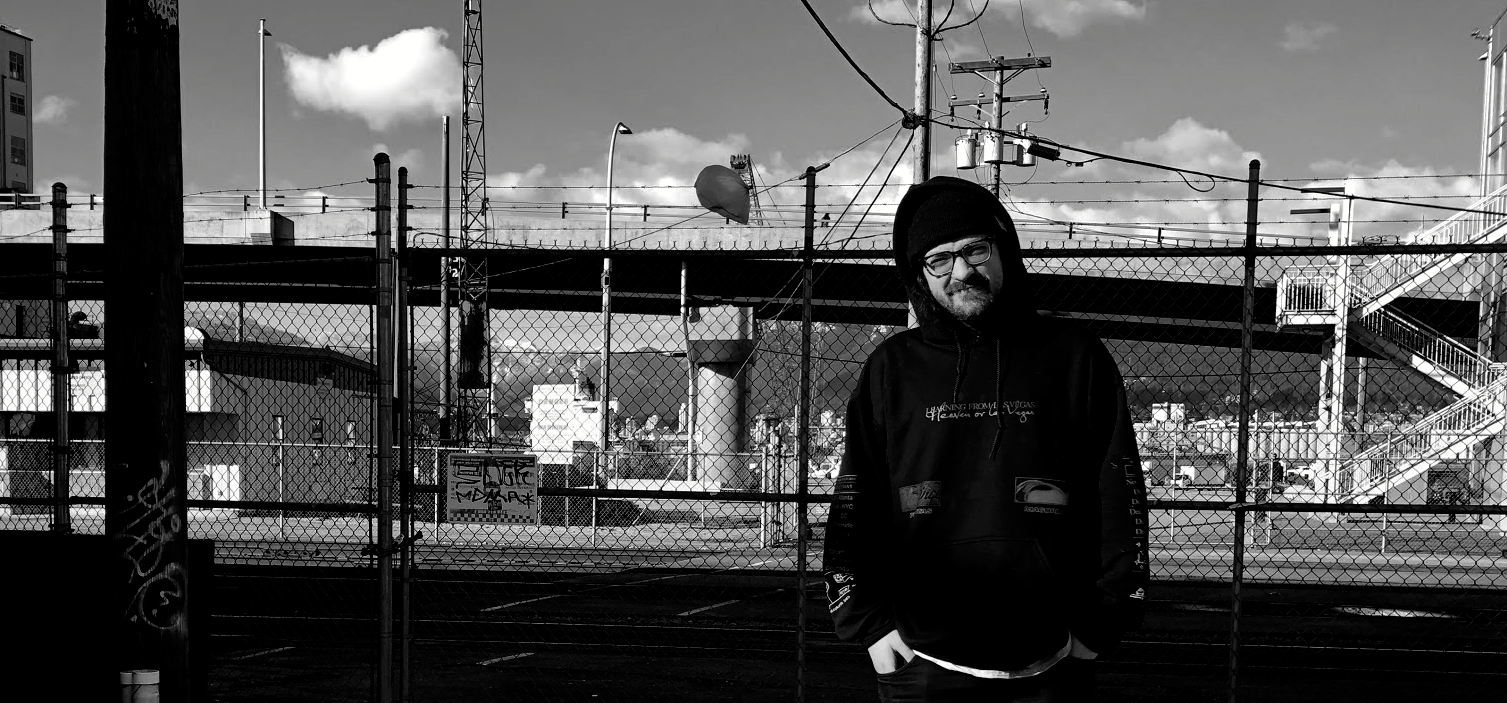
Zach, aka 1800HaightStreet and ZDBT, posing in front of the Vancouver Harbour

If you live in Vancouver, are any bit a of homer and enjoy new techno, then it’s likely that you’ve encountered 1800HaightStreet. Their driving melodies and billowing percussion have captured ears around the world, and for good reason. The duo has been producing and playing music for longer than a decade. Zach, known as one half of the 1800HaightStreet project and ZDBT, is a beaming example of musical proficiency, self-affirming excitement and commitment.

Fresh off the back of a European live tour, Zach sat with me to chat history, production, and plans for the future. What follows is a framed and summarized representation of our exchange.


they say being a touring DJ is really hard on your mental well-being, but I think being in a punk band in a crappy vehicle, touring Canada, is probably a lot worse. But, it was still fun. I wouldn’t trade that.

Zach was born and raised in Winnipeg. He began playing the drums early: at home and at school as a percussionist. His mother bought him his first drum set at the age of ten, and encouraged him to play to his heart’s content. Since then, he has taught himself how to play, aside from some training in Latin and Afro-Cuban grooves.

He moved to Vancouver in 2008, where he began working and playing in bands. His first tour was with hardcore punk band Sick Charade in 2011, and his last was with Summering in 2015. By that point he was pretty saturated by band life and decided to transition out of it. “I got pretty fed up with playing in bands,” he told me, adding that  “they say being a touring DJ is really hard on your mental well-being, but I think being in a punk band in a crappy vehicle, touring Canada, is probably a lot worse. But, it was still fun. I wouldn’t trade that.”

Since then, the duo has exhibited some remarkable output. They tend to write music independently and assist the other in post-production. At the moment, Zach is churning out a track nearly every day. This makes for an abundance of work to choose from when it’s time to collaborate with a label on releases. With such a brimming portfolio, I have no doubt that 2019 will be a productive year for the 1800HaightStreet and ZDBT projects.

It was with a couple friends and bandmates, Todd and Hunter, that Zach decided to part ways from the challenges of band life, sell his drums and pick out some synthesizers. With a name from Todd to reflect the psychedelic movement of West Coast Bay Area hippies, Zach and Hunter collaborated on production that led to their first release, The Pursuit, in 2015.

When Zach and Hunter aren’t touring or in the studio, they may be on a film set. Both of them pay the bills on a lucrative film payroll, with Zach working in props and Hunter in set decoration. Zach’s schedule is less demanding so he tends to be in the studio more often and has more opportunities to perform. Nevertheless, the duo often collaborates on adapting tracks for live performance, so they have a robust live arrangement at the moment. “I prefer doing live stuff in general,” Zach explained, adding that “DJing will be mostly a solo thing in the future. It’s fun to DJ back to back, but it’s hard to do that all the time. I like to be able to explore within a DJ set.”

This is a natural progression for Zach. He’s been listening to techno since the 90s when his uncle worked in a record store where he showed him some of the decade’s coolest electronic music. “[My uncle] used to make me mix tapes with banging techno and acid on it, like Hardfloor, and lots of 90s shit … I was really obsessed with the ‘Hackers’ soundtrack,” he told me.

With 30 years of techno along with hundreds of hours of solo studio work, I imagine that both his live and DJ sets are robust. I’ll be catching him in Vancouver on March 30th at Open Studios. Parties in Victoria and Edmonton are also in the works, with some European dates on the horizon.

Watch Lobster Theremin’s label LTBLK as well as Vancouver-based labels for Zach’s 2019 releases. Aditionally, watch out for a new project colab titled “Dosis” by Isla label boss Nap, and ZDBT

1800’s latest album Age is available now on Bandcamp.

Find  ZDBT’s tunes, and FM work on Youtube, Mixcloud and Soundcloud.

Thank you for your time and your words, Zach!

Are there any producers from the Vancouver area who you are interested in knowing more about? Please let us know in the comments or via email.

Adam

The most important thing to understand in job searching: value

Reddit submission here.

Today I’d like to talk about what I think is the most important thing to understand in job searching: value.

I hope this could be helpful to some of you who are currently struggling to land your dream job, or finding a job at all.

I personally learned this the hard way so I like to share some of my learnings.

In order to understand value on a deeper level, you need to understand that everyone can create value.

Everyone is valuable

This may seem a cliché to a lot of you, but everyone is valuable.

Obviously, everyone could create something, and that's why people even have jobs to begin with, duh.

But a lot of times, when people are in the job application process, or during an interview, they completely forget that they could add a lot of value to the company they're trying to get into.

A lot of people would lack the confidence to believe that simply because they are beginners.

I’m here to tell (and hopefully show) you everyone is valuable to someone.

You have to remember that you’re here to bring value to a company; you're NOT begging for a job or anyone’s sympathy. You are here to create value, solve a problem, generate new ideas and help grow the business.

My point is, employees are paid for a reason:

if the employee adds value to the company, the company gives the employee values in return (e.g. money/salary).

There’s no need to feel insecure or insignificant about yourself when dealing with larger entities of people, be it the BigN, or your dream company.

Now, this is not to say that having value to add guarantees you a job at your dream company because another thing you need to understand is fit.

I don’t want to go on a huge tangent and talk about fit, but the basic understanding should be that sometimes the values you bring to the table may not be what the company is looking for at the time.

It’s just luck sometimes: this particular department in this company is looking for a particular skillset for this particular project at this particular time.

So don’t be too hard on yourself when you get rejected.

And definitely don’t shy away from following up a couple of months after rejection.

Most of the time though, you can still get your dream job if you understood how to align values.

Value alignment.

For the majority of my career, I had been a freelancer.

In the beginning, I was just being, you know, a typical freelancer.

I was doing web development and design and a little bit of Internet Marketing, but it was mostly spec work.

People would come to me and give me detailed requirements, both technical and design.

And they would ask me to code it out, be it a website or a web app, or a mobile app.

I was doing what a good developers/designers would: follow industry standards and best practices.

I cared about things like code maintainability, separate of concerns, responsive design, etc. And on the design front, I was keen on simple and minimalistic designs that create great contrast and hierarchy.

I was also advocating all of those things to my clients to educate them about the technical side of things.

Believe it or not, I was actually very proud of myself for being a freelancer who doesn't just do the work, take money and be gone, but instead be the one to help clients understand what goes into the work.

It all worked out fine until one day, one of my clients said to me

Dude, I appreciate you telling me all about the technical stuff. It sounds cool, though it sometimes sounds foreign to me. But honestly, I don't give a shit.
I care about getting more customers and having steady cashflow much more than responsive design or whatever.
And now, I just want a goddamned website.

And he was right.

In that moment, I felt both embarrassed and relieved because I finally figured out what I was missing:

I was too caught up in what I valued and completely neglected my clients’ values.

It’s true that I could just bring up some UX research on how the boring “technical stuff” can help drive revenue, I chose to be humble and embrace the mindset change.

Information about responsive design or functional programming or whatever may be interesting to the clients, but most of the time, they would much rather talk in terms of customer acquisition and revenue.

So from then on, I’ve learned the importance of value alignment.

I learned to think in my clients’ shoes and figure out how to use my skill set, based on what I value, to help my clients achieve their goals.

Of course, I didn’t stop trying to create beautiful designs and maintainable code.

But once I was able to align our values, I ended up creating more value for my clients and increase my own self-worth in the process.

A healthy side effect of this is I also started getting better clients and charged more.

Applying this to job searching or interviewing, I was able to align what I had to offer with what the company needed based on my research.

I was more valuable when I focused on how I could add value to the company and help them achieve goals than when I was only thinking about my own values.

At this point, you might be wondering:

What happens if I don’t any unique set of skills to differentiate myself from others?

As I mentioned before, everyone can create value, even beginners (especially beginners sometimes).

Being able to align values will make you more valuable and stand out amongst crowd given that:

  1. You understand the big picture: values and alignment;
  2. You can adapt/align your skill set to the company’s need specifically: good fit.

By understanding value and communicating how your values align, you can more or less make it a no-brainer decision to hire you!

Making it a no-brainer

Building on top of that, you can dramatically improve your portfolio or resume if you could clearly convey the values you provide and how they align with the company’s value to stand out even before interviews.

After all, the interviewer’s job is to fish out what value you bring to the table and whether or not it can help the company achieve goals.

This could take in the forms of a case study or a hand-picked mini-portfolio made specifically for the company you are applying for.

What this does is it takes out a lot of the doubts that the interviewer may have about you and drastically speed up the hiring process because all the answers are presented to them without them needing to think.

Annnd that’s it for now. I do hope this information is valuable to you all and help make your job searching journey easier!

In the future I may write about how to apply this mindset to practical actions in order to stand out and increase your perceived value. So stay tuned and subscribed to the newsletter 😉.


If there's anything else you would like me to cover regarding job searching, interviewing, portfolio building, or anything else in life, just hit me up!

Who am I ?

Hey, this is Valentina! I am a co-op candidate for the Bachelor of Communications at Simon Fraser University. With curiosity and enthusiasm for public relations and marketing management, I have focused on courses related to advertising and political spheres in communications. Communication courses enabled me to develop a broader vision of the world, and a critical awareness of how effective communications can contribute to business goals and relationships.

Communications courses allowed me to enhance analytical, research and writing skills. To distribute contents in more effective and aesthetic ways, I learned about the ethics and principles of graphic designs and photography from interactive-arts courses. Proficiency in Adobe Creative Cloud suite and Microsoft office made me become more productive in organizing contents in multiple platforms.

I truly believe that effective communication can strengthen the relationships between audiences and authors, business partners, even the states and the public. The academic and practical aspects of Communications study along with my creative thoughts push me to strive for more possibilities in this field. I am highly interested in building bridges of communications and help organizations, firms, and people to connect with more people.

For any inquiries, please contact me at vallyding@gmail.com.

Week 8 Process Post: Brand Backlashing

This week in class, we were given a group activity where we were to look at different case studies regarding brands who have experienced backlash on social media for some of the ways they market their products. Some examples of backlash that have been on the news include: Gucci’s black face sweater, Katy Perry’s blackface shoes, and H&M’s monkey sweatshirt.

For the group I was in, the case study we were given was Forever 21. They were given backlash after sharing a photo on twitter of a white model wearing a sweater saying “Wakanda Forever.” What was interesting and amusing to see from some of the backlash was that some people weren’t offended by the fact that a white male model was wearing the sweater, but more so at the fact that Forever 21 couldn’t choose a better colour scheme for the sweater which made it look hideous.

Peer Review #2: Kristina Gorobets “speculating about creativity and life”

For this peer review, I will be taking a look at Kristina’s “speculating about creativity and life.”

At first glance, I was pleased with the simplicity of the theme of the website and how easy it was to navigate through on mobile. I wasn’t able to access the first peer review on Kristina’s blog due to the link of her first assigned peer review partner’s blog not working, so I’m not sure what they originally suggested to Kristina in terms of improvements that could be made. Therefore I’ll be giving my own thoughts as to what can be improved on.

As the concept of her blog revolves mainly around visual design and art, one minor thing I would suggest to make your posts more vibrant is to add some colour in your text opposed to keeping it at a default colour for every post. I know some colours may be hard to read, so perhaps something like blue, purple or green will work.

I would suggest to also keep content that pertains to her blog and keep all other content such as the PUB 201 assignments hidden on the front page of her blog. One plugin I personally use is “WP Hide Post,” which is a pretty simple tool to hide the posts you don’t want to be shown on your front page through the click of a button. As for the “ABOUT” page, I do think the recent posts and categories widgets on the right hand side takes a bit of the attention away from your actual about section, and would be better to leave it completely out.

Lastly, I see that Kristina has different categories or themes for each of her posts such as “editor’s pick,” “for fun,” “stories,” etc., maybe something you can do with these is to add these categories into your “Blog” menu. That way your audience will be able to get a feel of the different kind of artwork that you’re presenting through a dropdown menu.

Telling by her Instagram that is linked to her blog which can also be perceived as a portfolio, I can confidently say that Kristina has a talent for art and that it is something that she is passionate about. I look forward to seeing what else she has to share in terms of her work.

Want to see Kristina’s blog for yourself? click here!

Process Post 7 – Feedback

Peer reviews are daunting. Completing a review for someone else is difficult, especially when you’re not necessarily an expert on the content (blogging), or when you, yourself have a blog that will receive a review in return… in exchange for a grade. They are also challenging to read when you’re under scrutiny; will they like what I have to say? What will they think about my photos? Will the content of my writing be clear, offensive, engaging or just plainly boring? I feel this is one of the issues we face as bloggers (I’m calling myself a blogger now, apparently); personalizing a space to reflect yourself and your interests, then publishing it for the universe to troll, critique and destroy. Blogging is simple, but it is not easy. What you post, share or reveal is vulnerable to what others think, and what others think can be as destructive, like Cyberhate, which you can read about here,  as it is liberating, enjoyable and of course, democratic (see a variety of #Posiel posts debating this). I argue for.

For the latest review I received, I was delighted to attain significant positive feedback from Jill’s Book Blog, which you can access here, but also some constructive feedback that will greatly benefit ReRouted. In being transparent, of course I take delight in reading her humbling feedback, but I truly value her primary suggestion that images/photos within the posts would better serve the overall layout and theme of the blog, as well as make the reading more approachable and intriguing. With this in mind, the process in which I encountered this week was incorporating photos directly into the blog and process posts, which involved consideration of suitability for the post and aesthetics.

Because much of the photography on my blog is of myself, I wanted to balance the images with ones that are less personalized, but still reflective of the content and overall theme of my experience of change. I feel that my blog is very personal, so in seeking greater balance, I am enhancing relatability and hopefully broadening the appeal of my content by doing this. I have done a lot of thinking about how my writing is interpreted by others, but have neglected the idea for how images can or haven’t been doing the same. Brown University has a fascinating presentation on why people perceive text differently, which made me think, perhaps my text isn’t what I think, and if so, or even if it is, how do photos support either conclusion?

In consideration of images, I wanted to be cognizant of colour, size and focusing on finding relatively simple images that support the writing as opposed to detracting from it. Likewise, I wanted the images to be a part of the writing itself, so as the image itself can offer some greater context or meaning of the conversation. I want the image to be an anchor in the post that organically reveals some of the content. I feel this is important because for many readers, busy ones especially, as well as keyboard warriors on the prowl, photos provide a quick glimpse into what’s new, relevant and a part of my thoughts and life. I also took some of Jill’s advice in having the layout of images reflect that of the landing page; like an advent calendar, which is what I was kind of going for from the conception of this blog. Notorious blogger, Neil Patel has some great insights on selecting images which you can read here. Additionally, Shout Me Loud outlines several reasons why including images on your blog is valuable, which you can also see here.

There is still some general tidying-up that needs to be done to enhance upload speeds, function and layout. I have been working on paper to come up with something a bit more user-friendly and hope to make these changes soon. I’m hoping to implement some more major edits soon, as I would like the blog to be a little more polished. That said, Jill’s comments regarding her appreciation for the content and the theme or feel of the blog is reassuring that I’m on the right track… for some people at least. For others, they can go here for entertainment value.

I want to extend a kind thanks to Jill for providing such a positive and helpful review; I only hope that I offered her even half the same in return. As many people as blogs reach, the act of blogging can actually be quite lonely. You are trying to build a community, but the vacuum in which you do so is a cyclone within yourself and your own interests. Your reach is far in terms of potential, but you’re in isolation, behind a screen, sharing what it is that you find shareable. This in and of itself is intimidating – here you are, in front of the world, one in which can judge you without repercussion, offering your thoughts, feelings and fears. The blogosphere is yuge, but like the universe, there are many constellations and systems to discover, view and get lost in.

Main St. Development in Photos

Below is a sequence of photos from Vancouver’s False Creek and Main Street area taken from the Google maps database. They date from 2000 to 2018 (excluding ’06 and ’10 – ’12).

It takes a few cycles of the GIF to notice changes. A particular area of interest is south of the water.

The stress associated with the transformation of old neighbourhoods and soaring property values have been felt in many modern cities around the world. Indeed, this problem may come to define era in coming decades.

This stress has a particularly tangible burden on cultural spaces, which tend to pull in less profits than a traditional business, especially if they are presenting alternative forms of media.

As you look at this sequence, consider how Vancouver’s landscape, or the landscape of any modern city, may come to accommodate cultural spaces. Where could those spaces be? What effects will the inclusion or exclusion of these spaces have on your city? Are these the right questions to ask?

I would love to read your answers to these questions in the comments below.

Adam